Posts

ONE HISTORY, TWO PERSPECTIVES

Image
The Dutch Government funds a four years research titled "Decolonization, Violence and War in Indonesia, 1945-1950" carrried out by the best brains of the country in the field of history, KITLV (the Royal Netherlands Institute of Southeast Asian and Caribbean Studies), NIMH (the Netherlands Institute of Military History) and NIOD (the Institute for War, Holocaust and Genocide Studies).  I quoted from the research website what it is all about :  The programme comprises nine subprojects and aims to answer questions regarding the nature, scale and causes of structural violence in Indonesia, considered in a broader political, social and international context. In this context, detailed attention will be paid to the chaotic period spanning August 1945 to early 1945 – often referred to as the  Bersiap  – and the political and social aftermath in the Netherlands, Indonesia and elsewhere. In short, the Dutch had problem when Indonesia proclaimed its independence...
INDUSTRIAL HERITAGE OF AMSTERDAM : FAMILY COMPANIES

Image
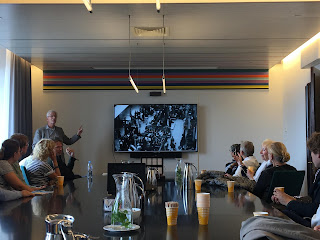
During the Open Monument Days, 8 and 9 September, so many monuments to choose but finally I made up my mind to visit family companies of Amsterdam. They are representatives of survived entrepreneurs with ups and downs plus owners of what would be industrial heritage of the city of the next century. I managed to visit three companies. First, the warehouse Bijenkorf. Surprisingly, this warehouse has established "The Cultural Heritage Foundation of Bijenkorf" in 2010. This foundation tasks are to compile historical data of the company in almost 150 years of operation and present them in attractive ways to large public. That was what we saw last weekend during the Open Monument Days. And we were allowed to see parts of the warehouse that is usually forbidden for public.  Second, the pickles company Kesbeke in Amsterdam West. I like their products, fresh, delicious and so local.  Third, for the first time since I move to Amsterdam 13 years ago I entered the Heineken ...

CARS AND POLITICS

Image
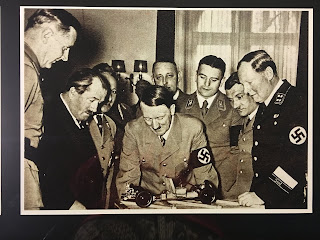
The Car Museum Louwman in the Hague has amazing collections but what for me most fascinating was the exhibition about relationship between cars and political leaders, for example Volswagen Bettle, Hitler and the first designer of the car who turned out to be Jewish or Churchill with his Humber Pullman.  About the VW Bettle, Hitler wanted to produce affordable and simple cars for Germany's road networks. In 1934 he asked Ferdinan Porsche to design the car. It should be a car that would be able to transport two adults and three children at the speed 100km/hour and use not more 7 litres of fuel per 100 km. Spare parts had to be easily replaced and acquired. Finally, in 1938 the first factory to build the People's Car (the meaning of VW) was opened in Fallersleben with a speech titled "Strength through Joy Car".  There was a story about involvement of a Jewish car designer named Josef Ganz, but in history books his involvement was disputable.  Hitler made...

FOOD AND HISTORY

Image
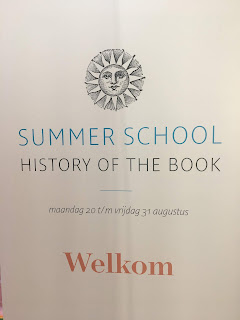
Thursday, 30 August, I followed a session of the Summer School "History of the Book" at the University of Amsterdam. I have chosen the topic "De Indische Keuken: Ontwikkeling van de Indonesische Keuken" (Indies Kitchen: Development of the Indonesian Kitchen) guided by Marleen Willebrands.  There were about 20 participants, mostly experts in the kitchen area, culinaire history and publishers of cooking books. There was also a cooking celebrity, a famous cook from the television channel 24Kitchen. There is a lady who will start a research about rice. There is a graduate from a master's study called 'Food History and Culture" in Brussels.  The more I learned about the other participants, the more I was fascinated how serious is relationship between food and history. It is also important to mention that most of them have direct and indirect relations with the Dutch Indies.  We analysed recipes about Indonesian dishes based on cooking books writte...

LOVE AND PASSION FOR MUSEUMS

Image
I have been involving in museum improvement programs in Indonesia for several years now.  I visited several museums in various cities in Indonesia and noticed that museums are not only about collections and management.  We can organize many trainings, many field visits as comparison and many discussions what the best museum is but in the end how we implement our knowledge and experience in running a museum.  There is one thing that I noticed about lively museums: they have always a good brigade of volunteers! These volunteers have love and passions about subjects of their museums and that is why they never get bored to involve in many activities.  It is love, it is passion that reflects back in aura of a museum so the museum doesn't look dead, dusty and soulless. Visitors see that, feel that and stay longer because of that. I know and experience it based on my own observation. Why some museums are lively and have good rate of visitors, other museums are...

THINGS THAT MATTER

Image
The current Exhibition "Things That Matter" in Tropen Museum Amsterdam is impressive for me. It is about things that are important in someone's life as an individual or as a society. It is an exhibition not only about tangible things but also the intangible like language and beliefs. Those are delicate subjects that are complicated to discuss in a global perspective since so much options and possibilities. Somehow, the curator of the exhibition could formulate those subjects into practical views and has chosen specific examples to describe theiw complexity. It is not simplicity, it is a means to explain. I appreciated it and enjoyed the exhibition tremendously. 

THE WORLD HERITAGE SITE OF TROY, TURKEY

Image
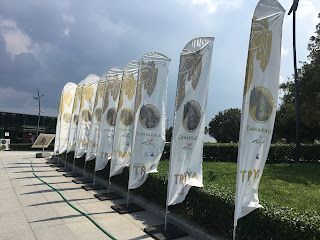
I visited the Ancient City of Troy, in Province of Canakkale, Turkey, 29 July 2018.  It is a world heritage site since 1998. Troy, with its 4000 years of history, is one of the most famous archaelogical sites in the world. It was founded when the archaelogist Heinrich Schliemann did his first excavations in 1870.  Troy is also famous due to the mythological Trojan Horse from a tale about the Trojan War, that was believed to take place in this city around 13th or 12th Century BC.  It happened after many years of endeless war, when the Greek had an idea to built a giant wooden horse to hide about 40 members of an elite force inside it . They sailed away and acted as if that horse was a gift to the Trojans who pulled it into their city as a victory trophy. That night the Greek elite force crept out of the horse and opened the gates for the rest of the Greek army who has sailed back. The independent city of Troy fell in the hand of the Greek.  That is w...