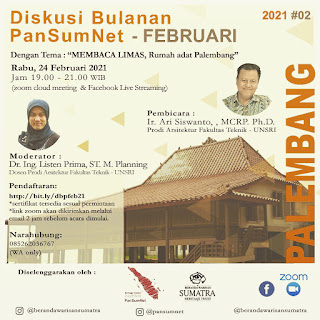
Diskusi Bulanan Pansumnet MEMBACA LIMAS, RUMAH ADAT PALEMBANG Narasumber: Ir. Ari Siswanto.,MCRP., PhD- Prodi Arsitektur Fakultas Teknik - UNSRI Moderator: Dr. Ing. Listen Prima, ST., M.Planning - Dosen Prodi Arsitektur Fakultas Teknik - UNSRI Rabu, 24 Pebruari 2021 Jam 19:00 - 21:00 WIB Media: Zoom Cloud Meeting dan Facebook Live Streaming Pendaftaran: http://bit.ly/dbpfeb21 *sertifikat tersedia sesuai permintaan Narahubung: 085262036767 (WA Only) Palembang selalu identik dengan Kerajaan Sriwijaya, Sungai Musi dan Rumah Limas. Karena letaknya yang strategis di tepian Sungai Musi, Palembang menjadi pusat pemerintahan sejak masa Sriwijaya dan pusat berkembangnya budaya sungai seperti pertumbuhan permukiman dengan beragam jenis arsitektur rumah tradisional. Ada dua jenis rumah tradisional di Palembang yaitu Rumah Panggung dan Rumah Rakit. Rumah Panggung diantaranya: Rumah Limas, Rumah Gudang, dan Rumah Panggung (Limas) Cina. Rumah Limas tidak hanya ada di Palembang, tapi juga ...
Posts
TALES OF TWO COUNTRIES
- Get link
- X
- Other Apps
February is a special month for me. I have migrated to the Netherlands in 2005 arrived at the Schiphol Airport on 11 February. Seven years later, in 2012, I became a Dutch citizen and took an oath at the Amsterdam City Hall on 23 February. I took those two events as crucial events of my life, together with several others. Migration and new nationality, how does it feel? Personally, I felt all processes were naturally happening as if they should have happened as a continuation of my life stories. I have met a Dutch partner, I brought my daughter to migrate to the Netherlands, and after several years I felt the necessity to have clarity for my daughter and myself about our nationalities. Both of us have Indonesian blood, nothing can and will change that, but nationality is a choice and we have chosen to be Dutch citizens. The Netherlands is a good country to live in, factually. The facts are: relatively well-managed basic needs infrastructure (health, education, social w...
CAPACITY DEVELOPMENT
- Get link
- X
- Other Apps
Capacity development is an effort that lasts for my whole period of interest in cultural heritage. It means in the mid1990s. It means more than 25 years and I am still doing it. I am still doing it independently because I started it in Indonesia and in Indonesia, nobody employs you if you work in the cultural heritage sector. In 2005 I moved to the Netherlands and I am still doing what I did in Indonesia: capacity development in the cultural heritage sector. I am still doing it independently because of the nature of my works that focuses more on the needs and characters of the cultural heritage sector of Indonesia. Fifteen years forward, I am content with my capacity development efforts. They can be seen on my website. They are limited and humble, but I did them all with my best intentions. Just to share a daily experience, yesterday, 25 January 2021, I had an online meeting for the Historic Urban Landscape cooperation. I saw the logo of my own affiliation (Heritage hands-o...
MY TWENTY TWENTY
- Get link
- X
- Other Apps
International Symposium on Water and Culture, Monday, February 3rd, 2020, National Graduate Institute for Policy Studies (GRIPS), Tokyo, Japan, (Organized by High-level Experts and Leaders Panel on Water and Disasters (HELP), National Graduate Institute for Policy Studies (GRIPS), Ministry of Land, Infrastructure, Transport, and Tourism of Japan (MLIT), UN Center for Regional Development (UNCRD/UNDESA), and ICOMOS Netherlands) Water nurtures a unique and diverse culture of a society that becomes a solid foundation of sustainable development of regions. Innovative paths for regional development can be found by looking at people’s lives and livelihood through a water lens. Leading experts on water and culture will present cases of rich water culture and their impact on regional society and economy. Good practices and lessons on water-related regional development will be shared from both historical and modern cases. The panelists discussed how the issue of water and culture can ...
Le Corbusier's Ghetto (and how the Dutch deal with it)
- Get link
- X
- Other Apps
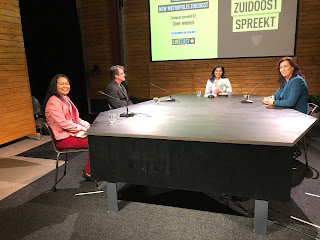
Last night I took a part in an online discussion for television and live stream programs with the representatives of the Municipality of Amsterdam and the Housing Corporation Rochdale about living in Amsterdam Southeast. It was organized by the New Metropolis Zuidoost, a branch of Pakhuis de Zwijger, a think tank for urban and sustainability issues. I had to be bold in five minutes that I had during the broadcasting. So what I said is that Amsterdam Southeast was built based on the ideals of Le Corbusier, the Swiss architect, that everyone no matter from which background has the right to light, air, and space. He dreamed of urban development that separated work, living, recreation, and various modes of mobility. This ideal was applied in Amsterdam Zuidoost in the 1960s to be the largest experiment ever in the world in terms of scale and innovations. The experiment was lead by Cornelis van Eesteren, the pioneer of modern architecture in the Netherlands. The reality showed that some...
MY PASSIONS FOR INDUSTRIAL HERITAGE
- Get link
- X
- Other Apps
In Indonesia, there are 33 former sugar factories that are older than one hundred years. And the plantation industry echoed the glorious past when Indonesia or to be more correctly, the Dutch Indies, supplied the world with the best tobacco, tremendous amount of spices, and other commodities. A story of industrial heritage is a story of the economic history of the country intertwined with stories of culture and people. Every time I saw a former and still existing industrial site, I am excited to learn and to find out more. On the other hand, I found a few resources from the Indonesians self. Most resources come from the archives and resources of the Netherlands. It shows that industrial heritage is not on the agenda yet in Indonesia. That is basically my motivation to promote the industrial heritage of Indonesia through ANIH, the Asian Network for Industrial Heritage, that was established in 2018 initiated by Taiwan. I would like to encourage the Indonesians, especially, about the...
HEALING THE PAST
- Get link
- X
- Other Apps
Indonesia is busy dealing with a lot of economic and social problems at this moment. I am hesitant to inform you of what I thought a milestone in the cultural sector today. But there is never a right moment if I wait. So I put forward what I think the Indonesians should know. In colonial times, there were many cultural goods were looted by the Dutch. The current Minister of Education, Culture and Science of the Netherlands, Ingrid van Engelshoven, would like to have a policy on what to do with those looted cultural goods. The Colonial Collections Committee was established about a year ago with the main task to provide advice to the Minister. I was humbled to be asked to join the Committee, together with the other nine members. On Wednesday 7 October 2020, we officially handed over our advice to the Minister. Later this advice will be disseminated in English and Bahasa Indonesia. For now, I share here the summary of the advice in English. I think it is worth reading since it is...
THE BEAUTIFUL SUMATRA
- Get link
- X
- Other Apps
I encouraged monthly discussions amongst heritage activists and organizations around Sumatra who united in Pansumnet (Pan-Sumatra Network for Heritage Conservation). Dialogue is very important and it is free. Why not? Since June, we have had consistently organized it. It was so energizing to listen to all speakers about their local activities and aspirations.
ONLINE WORLD
- Get link
- X
- Other Apps
The positive side of the COVID19 pandemic is that everybody is forced to get used to the online world: meetings, seminars, and many more. For a migrant like me, the online world intensifies contacts with Indonesia. I don't have to fly 14 hours to be a speaker in a seminar or a forum. I am content with this. I think this is more environmentally friendly than the old-style way of traveling. Does the online seminar effective? For me it is. The online seminar is nothing less, it is more to the point and efficient in terms of logistics and budget.