Posts

MINDFULLNESS EXERCISE FOR THE YOUNG ARCHITECTS
Image
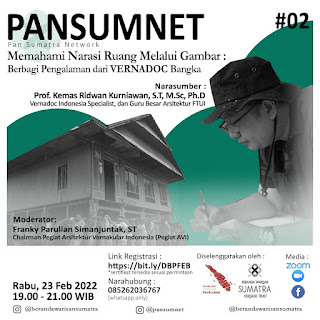
Always happy to get in touch with friends and colleagues from the field during the webinar of Pansumnet about manual documentation of vernacular architecture in  Muntok, South Bangka, Sumatra by Vernadoc Indonesia.   Vernadoc tries to document vernacular architecture manually. A skill that is fading away for the younger generation. It takes time of putting all information on paper with a pencil and pen. As the speaker, Prof. Dr, Kemas Ridwan Kurniawan, said, it is a slow process of understanding and loving the vernacular architecture. You wouldn't do it if you are in rush.  A kind of mindfulness exercise especially for the young architects.
A COURAGEOUS GESTURE

  February 17, 2022, the Prime Minister of the Netherlands has apologized to Indonesia for what the Netherlands has done during the period of 1945-1949. A deep excuse, he said. This is the third time that the representatives of the Netherlands apologize to Indonesia. In 2005, the Ministry of Foreign Affairs was the first, and in 2020 the King of the Netherlands was the second. The third apology followed the launching of the results of the multiyear research on Independence, Decolonization, Violence and War in Indonesia 1945-1950.  The launching began early in the morning through a live stream in two languages (Dutch and English). There are many results of this research in publications and audio-visual documentation. This factsheet shows a comprehensive but compact overview.      What do the Indonesians think about the research? If the Director-General of Culture, Hilmar Farid,  as a representative of the Indonesian Government might be considered to rep...

TRACING THE SPICE ROUTE

Image
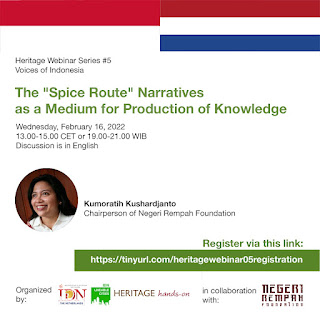
Heritage Webinar Series #5 Voices of Indonesia Wednesday, February 16, 2022 13.00-15.00 CET or 19.00-21.00 WIB Discussion is in English The "Spice Route" Narratives as a Medium for Production of Knowledge Speaker Kumoratih Kushardjanto Chairperson of Negeri Rempah Foundation Registration via this link: https://tinyurl.com/heritagewebinar05registration Organized by: Heritage hands-on , Indonesian Diaspora Network the Netherlands (IDN-NL), and IDN Liveable Cities (IDN-LC). Contact Hasti Tarekat heritage@idn-lc.nl Spices became a reason for European trading vessels to come to the Indonesian archipelago. It was the history of survival, competition, violence, and repression. Fast forward to the 21st century. How do the Indonesians interpret this history and what do they want to do with it? Negeri Rempah (Spices Land) Foundation is one of the leading players in promoting narratives of spices history amongst the Indonesians, especially the young generation.  ...

LEGAL STRUGGLE AND ENFORCEMENT

Image
Legal protection of historical buildings and sites has been a long struggle in Indonesia. It is important to establish a solid legal base as a foundation for the heritage movement in the long run. And that is only a fraction of the whole story because after the legal base is set up, another challenge comes up how to enforce the law and regulation into practice.  Medan and Sawahlunto are two of the examples in Indonesia as cities that have been trying to have effective local regulations to protect historical buildings and sites. I like to quote the Beatles lyrics, “it has been a long and winding road” in many facets. From the 1990s up to now. One step at a time. Rise and fall.  Isnen Fitri from Medan and Rahmat Gino from Sawahlunto can tell us all what they have been through. Discussion is in Bahasa Indonesia ~~~~~~~~~~~~~~~~~~~~~~ Penetapan Cagar Budaya Kota Medan dan Sawahlunto  Rabu, 26 Januari 2022 19.00-21.00 WIB Pembicara Rahmat Gino Sea Games, ST., MT Dinas Kebudaya...

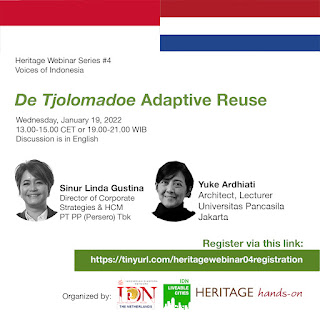
De Tjolomadoe Adaptive Reuse

Image
Invitation Heritage Webinar Series #4 Voices of Indonesia De Tjolomadoe Adaptive Reuse Wednesday, January 19, 2022 13.00-15.00 CET or 19.00-21.00 WIB Discussion is in English Speakers Sinur Linda Gustina, Director of Corporate Strategies and HCM PT PP (Persero) Tbk Yuke Ardhiati, architect and lecturer, Universitas Pancasila   Registration: https://tinyurl.com/heritagewebinar04registration Organized by: Heritage hands-on , Indonesian Diaspora Network the Netherlands (IDN-NL), and IDN Liveable Cities (IDN-LC). Contact Hasti Tarekat ( heritage@idn-lc.nl ) De Tjolomadoe sugar factory in Surakarta was built in 1862 by the principality ruler Mangkunegara IV. The factory was part of the sugar industry in Java as the world’s second-largest sugar exporter after Cuba in its heyday. The development of de Tjolomadoe Factory has contributed to the success of the sugar industry by setting a production record of 30 million tons in 1930 and has become an export c...

ALPHABET, LOCAL WISDOM AND HEROES

Image
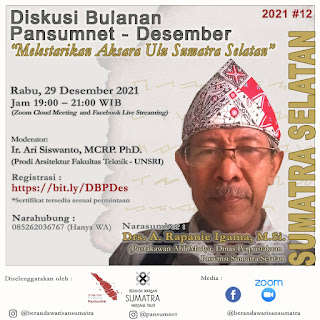
The monthly discussion of the Pan-Sumatra Network for Heritage Conservation (Pansumnet) on 29 December 2021 was about the efforts of Rapanie Igama, a library expert,  to save the Ulu alphabet in the South of Sumatra. When I asked how many local languages, dialects, and alphabets exist in his area, the answer is astonishing: more than 70 dialects. And that is only in one province or area of South Sumatra!  It was more astonishing when other language experts, Sarwit Sartono from the University of Bengkulu and Prof. Dr. Uli Kozok from Hawaii also joined and enlighten the audience about the Ulu alphabets. Those alphabets are actually the doors to much local wisdom about daily life that are actual now such as environmental issues, agriculture, and many more. It is a pity that very few people left who can understand the language and the content.  We discussed a lot about the digitalization of the alphabet but finally, we drew a conclusion that digitalization is not only about u...

TECHINICAL GUIDANCE OF MUSEUM MANAGEMENT

Image
I am humbled to get involved in multi-year cooperation (2018-2021) between Indonesia and the Netherlands to organize a series of training about museum management.  The involved organizations are the Ministry of Education, Culture, Research, and Technology of Republic Indonesia. From the Netherlands is the Cultural Heritage Agency of the Netherlands, Reinwardt Academie, and the Embassy of the Kingdom of the Netherlands in Jakarta.  The previous training took place in Yogyakarta and Jakarta (2018), Semarang and Malang (2019). Unfortunately, the covid19 pandemic has blown away the plan to organize two training in 2020. So here we are at the end of 2021 with two hybrid training (live and online). The hybrid training takes place in Bandung between 29 November-3 December 2021.  The 'live' participants are 50 representatives of museums from all over Indonesia. The 'online' participants are 12 representatives.  The speakers are 6 museum experts from Indonesia and 4 museum ex...

HISTORIC URBAN LANDSCAPE (HUL) QUICK SCAN METHOD HANDBOOK

Image
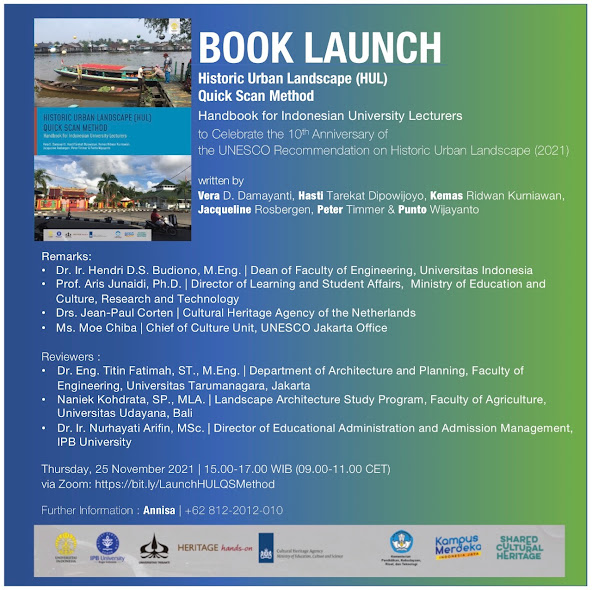
After two workshops in Muntok (2018) and Banjarmasin (2019), and almost 2 years working together to compile the lessons learned, finally this week we can launch the Historic Urban Landscape (HUL) Quick Scan Method, Handbook for Indonesia University Lecturers. 

CHINATOWNS IN SUMATRA

Image
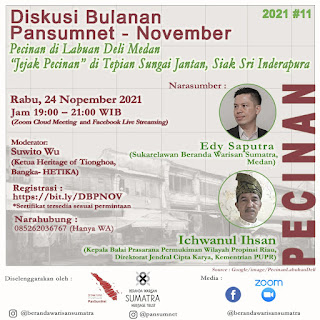
 A lot of cities and towns in the world have a Chinese quarter, also in Sumatra. It is part of an urban morphology that is fascinating to discover. In Sumatra, some Chinese quarters are vivid and alive, some are dying or even almost disappear.  During the monthly discussion of Pansumnet, we are going to listen to the stories about the Chinese Quarter of Labuan Deli in Medan and Footprints of the Chinese Quarter along the Jantan River in Siak (it was burned in 2018 that is why only has the footprints).  Discussion is in Bahasa Indonesia. ~~~~~~~~~~~~~~~ Pecinan Di Labuan Deli Medan dan Jejak Pecinan di Tepian Sungai Jantan, Siak Sri Inderapura Rabu, 24 November 2021 19.00-21.00 WIB Pembicara: Edy Saputra (Sukarelawan Beranda Warisan Sumatra, Medan) Ichwanul Insan (Kepala Balai Prasarana Permukiman Wilayah Propinsi Riau, Direktorat Jendral Cipta Karya, Kementrian PUPR) Moderator: Suwito Wu (Ketua Heritage of Tionghoa, Bangka- HETIKA) Media: Zoom Cloud Meeting dan Facebook L...

PLACE MAKING FOR HISTORICAL BUILDINGS IN JAKARTA

Image
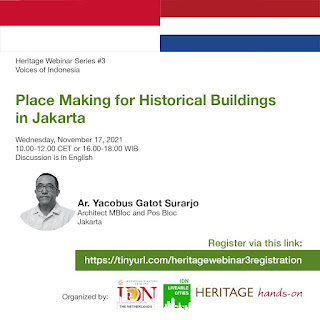
Place-Making for Historical Buildings in Jakarta  November 17, 2021 10.00-12.00 CET or 16.00-18.00 WIB Discussion is in English Speaker Ar. Yacobus Gatot Surarjo (Architect MBloc and Pos Bloc, Jakarta)    RSVP via e-mail  heritage@idn-lc.nl Join automatically via Zoom or login via the website of Zoom with Meeting ID: 932 9370 2320 and Password: 416776 Organized by Heritage hands-on, Indonesian Diaspora Network the Netherlands (IDN-NL), and IDN Liveable Cities (IDN-LC). Contact Hasti Tarekat Dipowijoyo heritage@idn-lc.nl www.heritage-hands-on.org www.idn-lc.nl P lace-Making for Historical Buildings in Jakarta Batavia (current Jakarta) has been built by the Netherlands-Indies Government since 1619 started from the north part and over the centuries expanded to the south part. Residences, public facilities, defense structures, offices, and warehouses were built as witnesses of flourishing economic development during the colonial era. The public facility included a po...

Industrial Heritage in Indonesia: Balancing Content and Packaging

Image
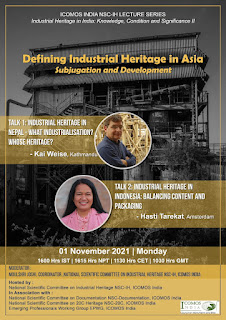
Defining Industrial Heritage in Asia- subjugation, and development: the Case Study of Indonesia. The summary of my views about the industrial heritage movement in Indonesia should have more balance as follow: Balance in interpretation, storyline, narratives.  Between technology and architecture, in times of peace and progress with the industry in times of war and occupation that is invisible, concealed, forgotten, repressed,  or erased. Balance in periods and geographical representations.   Between historical facts from the past with rising and fall of the industry at present days.  Between local, national, regional, and international contexts. Balance in values and valorization.  Between passing the heritage spirit and accommodating the fun elements.  Between temporary and short-term programs (educative recreational) and permanent and long-term programs (educative scientifically).

HERITAGE, DISASTER AND CONFLICT

Image
In English, it is called contested heritage. In Dutch, it is called beladen erfgoed. In Indonesian, it is called pusaka konflik , at least by Sylvia Agustina, a university teacher from Banda Aceh who graduated from USA and Singapore. Pusaka konflik is not much addressed yet in Indonesia. This webinar revealed stories from the field that is known to be tough in history with natural disasters and political turmoil: Banda Aceh. Sylvia has been trying to map potentials of contested heritage in the city where she lives and works especially those that relate to the Tsunami in December 2004 and a long battle of GAM ( Gerakan Aceh Merdeka -Free Aceh Movement) with the military of the Republic of Indonesia. I think what Sylvia has been doing is an essential step for the local Acehnese to learn more about themselves. The gigantic natural disaster and the political turmoil were beyond words to describe, but each local Acehnese must have opinions and experiences about them and those are very valu...

FASCINATING PLANTATION HISTORY

Image
The plantation history of Indonesia is one of the most fascinating histories for me because it embraces many elements: industry, economy, social, culture, migration, globalization, and I can add more and more angles.  If I relate it to the shared history between Indonesia and the Netherlands, the plantation history as if still alive because I could find many traces in both countries.  The last webinar about shared history was about the plantation history at the Eastcoast of Sumatra (current North Sumatra). Indonesia was represented by Museum Perkebunan Indonesia-Musperin (the Indonesian Plantation Museum) in Medan. The speaker, Sordjai Kartasasmita is one of the founding fathers of the plantation industry in Indonesia and the initiator of the musea (yes, Musperin has two musea).  When I searched the traces in the Netherlands, I found quite a number of essential traces. The multinational Deli Maatschappij is now Deli Home. Villa's of the plantation pioneers are still intac...

Building a Bridge

Image
Indonesia and the Netherlands have been building a bridge of understanding for some time especially for themes of shared history and shared heritage. The truth is that both sides have their own angles which are completely logical. As a cultural heritage professional, I would love to see both angles. That should be ideal. The reality is that ideal is difficult to achieve. So every time I have to face the reality, I accept that the ideal approach would never be achieved or presented. The highest expectation that I could have is that both sides exchange their angles. I can live with it. Shared history and shared heritage are celebrated or contemplated differently in Indonesia and the Netherlands as long as I can observe as a practitioner in the field in both countries. I save more details about my opinion for other opportunities, but what I would like to say is that difference makes this job attractive for me. I have been doing this job for almost three decades and it is getting more and ...
Image
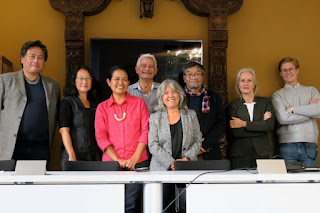
Exchanging thoughts and ideas with the exhibition team of Museum Sophiahof in Den Haag in a constructive discussion on 6 October 2021 related to their exhibition about shared history with Indonesia, opened in February next year.  A positive initiative of Museum Sophiahof to communicate more and be open with related stakeholders. Indonesia and the Netherlands have shared history and communication helps to be open to the other side of the history.  (Photo: Max Meijer)

Validate, Sensitize, Celebrate! How do we do these in Asia?

Image
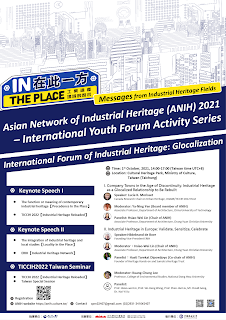
On Friday 1 October 2021, I became a panel member for the session about Industrial Heritage of Europe presented by Hildebrand de Boer, Board Member of ERIH (European of Industrial Heritage), and several more positions in industrial heritage. The basic idea of his presentation was the development of the industrial heritage movement in Europe since his involvement in the 1970s. He divided the development into three phases: validation, sensitization, and celebration.  ERIH (European of Industrial Heritage) is one of the impressive results of the development and it is developing until now. Check this out for details  https://www.erih.net/ As a panelist, I responded that if the industrial heritage movement in Asia inspired us to develop similar routes, we should at least consider three things: selection strategies, patterns of justification, and interpretative approaches, as Soyez, D. (2009) stated in Europeanizing Industrial Heritage in Europe: Addressing Its Transboundary and Dar...

GO LOCAL!

Image
There is a positive movement in Indonesia for at least two decades. It is a movement to dig tangible and intangible localities: from local materials, local agriculture, to local traditions in a broad sense. Fithrorozi Belitong is one of the leading actors in the locality movement. He has been reviving and keeping the local language of Belitung alive. He writes books, organizes a youth group, and publishes e-flyers to raise awareness of identity through local language and literature. Indonesia needs more of Fithrorozi’s. The webinar is in Bahasa Indonesia. ~~~~~~~~~~~~~ LITERASI ASAL MUASAL PULAU SUMATRA Menggali Ilmu dari Tradisi Lisan Para Orang Tua Rabu, 29 September 2021 Waktu: 19.00-21.00 WIB Pembicara: Fithrorozi (Komunitas Telinsong Budaya, Belitung) Moderator: Arry Aditsya Yoga (Belitong Geopark Youth Community) Media: Zoom Cloud Meeting dan Facebook Live Streaming (Link Zoom akan dishare melalui email sehari sebelum acara) Live Streaming di Facebook Page BWS: https://www.faceb...

CONNECTING TWO COUNTRIES

Image
I often experience a fascinating situation when I discover that some people in Indonesia and the Netherlands are busy with the same thing while they do not know each other and have no contact whatsoever about the existence of the other party.  An example is the history of the tobacco industry.  The Indonesian Plantation Museums (yes, two museums!) in Medan are busy with establishing the museums and one of the content is the tobacco history in Deli, the East Coast of Sumatra. And then I visited the Nijkerk Museum, they told exactly the same thing: tobacco history, including relations with the tobacco history from Deli in the past.  Or the restoration of the Fort van den Bosch in Ngawi, East Java, by the Indonesians while I was biking regularly to the legacy of Johannes van den Bosch in the Province of Drenthe with museums, houses, and much more tangible and intangible heritage.  Historical connections are to find out later, but we have enough hints to understand that ...

HERITAGE AND CLIMATE CHANGE

Image
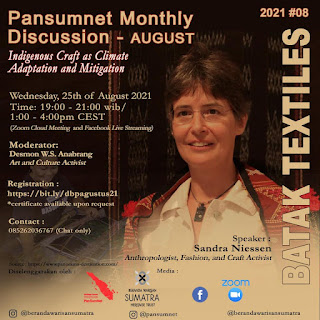
What is the relation between heritage and climate change? The relation is strong and a lot. Take an example of the protected national parks in Indonesia that go through deforestation now. Or the machine textiles production that cost a lot of water and energy. We can go on and go on with examples. This time, Sandra Niessen, an expert on the traditional textiles of Batak (North Sumatra), will talk about three themes that pertain to textile heritage and climate: Craft and Culture: systems of meaning vs emphasis on the visual, Craft and Economics: a double-edged sword, Locality, and Craft: implications of trade. 

MUSEUM OF SOEKARNO

Between 8-12 August 2021, I became one of the judges for a competition to design a museum for the birth house of Soekarno in Kampung Peneleh, Surabaya. The competition was organized by Tata Matra Indonesia and  Dinas Kebudayaan dan Pariwisata Kota Surabaya (Agency for Culture and Tourism of the Municipality of Surabaya). The aim was to raise awareness about heroism amongst the youth.  The other judges were Prof. Dr. Ir, Johan Silas, Ir. Dadoes Sumarwanto MArch., Prof.Dr. Purnawan Basundoro S.S. M.Hum., Zaky Umara ST. MALA, and Dimas Nugroho.  All participants were architecture students or graduates so they used architectural approaches with ideas about how a museum should look like.  Despite the fact that most submissions were impressive, I thought it should be better if students and graduates from museum studies participate, too. This would strengthen the ideas and be also fairer to the museum's professionalism. It is not everyone can create a proper museum. Nevert...