Posts

PANSUMNET: SMALL IS BEAUTIFUL

Image
During 1997-2005 I lived in Sumatra Island, a population of 80 million, Indonesia. I traveled from end to end, to most of the villages, from Aceh to Lampung. This island has a very rich culture: customs, languages, foods, traditions, architecture, countless. Since I couldn't find any heritage organizations, I started to look for local contacts who were active in preserving local culture. After a year or two, there were about 14 organizations in Sumatra who got to know each other and shared similar passions for cultural heritage. All of us agreed to unite ourselves in a network called Pan-Sumatra Network for Heritage Conservation (Pansumnet). We organized training and gathering periodically to exchange experiences and mostly to encourage each other to keep going despite challenges and limitations.  Anno 2020 Pansumnet survives and keeps its Whatsapp Group actively. We have also a monthly discussion with speakers from various islands. This is a network of individuals who work on gras...
HISTORIC URBAN LANDSCAPE (HUL)

Image
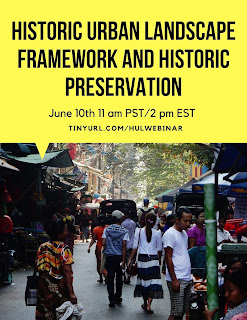
Raising awareness and increase the capacity of all stakeholders in cultural heritage management is a long term effort. There are many colleagues and friends who have been dedicating their time, energy, and resources to do that. They are my inspirations. One of the efforts is to raise awareness and to increase capacity about Historic Urban Landscape (HUL).   Heritage is not a dead monument, it has a soul and that soul rooted in its context, surrounding, and people around it. In Indonesia, we have taken small steps to introduce the concept of HUL in Muntok and Banjarmasin. We were simply facilitators, the local authorities and communities were the main actors. During this COVID19 pandemic, we keep continuing to disseminate the efforts through webinars and distribution of the reports. They are free to download.

DUA PAHLAWAN PELESTARIAN AMSTERDAM

Ada dua orang yang saya jadikan panutan dalam hal pelestarian bangunan dan kawasan bersejarah di Amsterdam : Paul Morel dan André van Stigt. Paul Morel adalah manajer proyek di Stadsherstel Amsterdam (the City Restoration Company of Amsterdam), sedangkan André van Stigt seorang arsitek spesialis konservasi yang mewarisi biro arsitek dari ayahnya, Bureau J. van Stigt.  Keduanya bekerjasama pertamakali 38 tahun yang lalu menyelamatkan sebuah gereja bernama De Posthoornkerk   . Setelah itu diikuti oleh proyek-proyek lain sampai mencapai 7 buah, semua dalam skala relatif besar dan signifikan dalam revitalisasi sebuah kawasan. Ketujuh proyek kerjasama itu adalah: Posthoornkerk NedPho-Koepel  De Hallen (Hal 17) Vondelkerk Pakhuis de Zwijger Haarlemmerpoort Muiderkerk Dua orang ini sama-sama mempunyai idealisme memelihara identitas dan sejarah Kota Amsterdam melalui bangunan dan kawasan bersejarah. Idealisme itu didukung bukan hanya oleh pengetahuan dan pengala...

15 TAHUN DI BELANDA : INTEGRASI

Image
Menjadi migran memperkaya wawasan dan pengalaman, tetapi juga menuntut penyesuaian lahir batin. Jika diibaratkan komputer, maka harus di- reset , diprogram kembali agar sesuai dengan sikon lokal. Nyaris semua hal terasa baru dan tidak menjadi sesuatu yang otomatis lagi sebagaimana di daerah asal kita. Bahkan hal sehari-hari pun seperti sosialisasi dengan tetangga atau menghadiri pertemuan menjadi tantangan tersendiri untuk memahami apa yang diharapkan dari perilaku dan pembicaraan kita. Apalagi semua interaksi dilakukan dalam bahasa asing, dalam kasus saya dalam Bahasa Belanda, yang pasti tidak sefasih penutur bahasa ibu. Dalam hal pertemanan dan sosialisasi informal, mental kita relatif lebih rileks untuk berhadapan dengan situasi dan orang baru. Kalaupun ada hal-hal yang kaku atau salah, bisa dihadapi dengan humor. Bukan berarti mendapat teman baru mudah di Belanda. Mereka umumnya baik dan ramah tetapi makna teman berbeda dengan Indonesia. Makna teman di Belanda kira-kira ...

15 TAHUN DI BELANDA: BAHASA

Image
Ketika saya menunggu dikeluarkannya izin tinggal sementara oleh Kedubes Belanda di Jakarta tahun 2004, saya mengambil kursus Bahasa Belanda selama tiga bulan. Lumayan untuk berkenalan dengan tata bahasa dasarnya. Ketika sampai di Belanda, menunggu sekitar setengah tahun untuk mulai kursus Bahasa Belanda sebagai bagian dari kursus berintegrasi dengan masyarakat Belanda ( inburgering cursus ). Jadi yang dipelajari bukan hanya bahasa tapi juga soal-soal lain yang esensial kehidupan sehari-hari seperti sejarah, kesehatan, tata cara berinteraksi, dan lain-lain. Tahun 2005 ini kursus wajib untuk imigran dan semua biaya ditanggung pemerintah.  Belajar sebuah bahasa yang baru pada umur 40 tahun lain rasanya dengan belajar bahasa ketika masih umur 20 tahunan. Dibutuhkan enerji ekstra untuk menghafalkan kata-kata yang baru. Untungnya saya tinggal di negara penutur Bahasa Belanda jadi proses belajarnya relatif cepat.  Mevrouw Loek dengan Dian Selain kursus resmi di CEC ( Cu...

15 TAHUN DI BELANDA: PEKERJAAN

Image
Pada musim dingin 2005 saya pindah secara permanen ke Belanda karena pernikahan. Tetapi sebetulnya affair saya dengan Belanda sudah dimulai sejak tahun 1999 ketika muncul artikel di koran de Volkskrant edisi Sabtu, 23 Januari tentang Badan Warisan Sumatra (BWS). Artikel dua halaman penuh dengan alamat email saya sehingga membuka pintu persahabatan dengan beberapa orang Belanda yang secara pribadi mempunyai ketertarikan pada Medan dan Indonesia. Sejak itu saya diundang secara regular oleh beberapa institusi di Belanda, diantaranya NAi dan ICOMOS. Kalau saya bepergian ke belahan dunia lain yang melewati Eropa, saya juga selalu transit di Belanda. Tiba di  Bandara Schiphol, Belanda, tahun 2005 Keluarga di Belanda, 2020 Sebagai orang Indonesia yang minat dan bekerja di bidang heritage, Belanda adalah surga karena arsip tentang Indonesia banyak di sini. Tapi sebelum bisa baca arsip, belajar Bahasa Belanda dulu. Jadi tahun pertama dan kedua saya kursus Bahasa Bela...

22TH ANNIVERSARY OF SUMATRA HERITAGE TRUST

Image
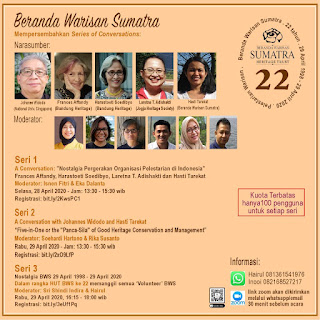
It was an honor to meet again with my seniors who introduced me to heritage about three decades ago. And so glad to see my junior colleagues took over the leadership to ensure that the heritage movement keeps going. Heritage movement in Indonesia is never been easy. As my senior said, heritage is about politics. But we have achieved certain things together all these years. Congratulations Sumatra Heritage Trust! Keep the spirit high, as always!

HUTAN PERANGKO

Image
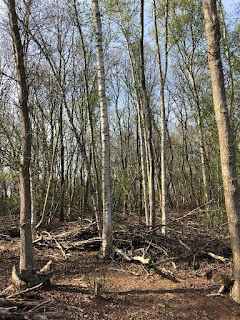
Saya selalu menyukai alam terbuka tetapi bekerja dengan tangan di alam terbuka baru saya lakukan setelah tinggal di Belanda. Pertama, di sepetak kebun di depan apartemen di Amsterdam. Saya menanam bahan-bahan sayuran sup (wortel, seledri, bawang daun), bunga dan buah stroberi. Ini saya lakukan terutama untuk memberi contoh pada anak saya, Dian, bahwa wortel asalnya dari tanah, bukan dari supermarket. Setelah Dian agak besar, kegiatan berkebun ini berhenti, terutama karena stroberi dimakan keong terus.  Kedua, sekarang saya sering menjadi sukarelawan merawat hutan lindung di propinsi paling utara di Belanda. Di hutan lindung itu ada binatang dan pohon-pohon lokal yang dilindungi sebagai ciri khas warisan alam setempat. Hutan lindung berukuran relatif kecil ini di Belanda dinamakan "postzegel bosjes" atau "hutan perangko" karena memang bentuknya petak  dan relatif kecil seperti perangko. Hutan perangko ini penting dalam ekosistem keseluruhan karena secara aku...

DAMPAK PSIKIS CORONAVIRUS

Image
Ketika banyak waktu di rumah untuk bekerja dan belajar,   seharusnya kita menjadi makin produktif. Tetapi ketika kabar datang satu per satu tentang kepergian teman-teman di Indonesia akibat serangan virus Corona, sulit berkonsentrasi jadinya. Saya mulai bertanya apakah ada artinya riset doktoral tentang profesionalisme organisasi heritage di Indonesia yang sedang saya lakukan? Ketika kita dihadapkan pada kematian, tiba-tiba kita dipaksa berkontemplasi tentang esensi kehidupan. Apa yang sebenarnya esensial dalam sisa umur kita? Di tengah buyarnya konsentrasi, seorang pembimbing membantu saya untuk kembali memikirkan apa yang sebenarnya saya cari melalui penelitian saya. Jika ada satu hal yang ingin saya temukan jawaban sebelum hidup saya berakhir, maka saya ingin belajar memahami bagaimana caranya agar organisasi pelestarian (heritage socities) di Indonesia bisa bekerja profesional. Bagaimana caranya agar teman-teman di Indonesia yang begitu berdedikasi luar biasa bisa ...

THE MAGIC OF BEING YOUNG

Image
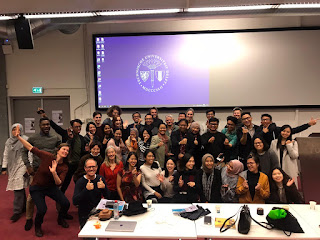
On Thursday 12 March, I was invited by TU Delft and ITB (Bandung Institute of Technology) to be part of the experts' panel on the campus of TU Delft. Both universities have cooperation called Shared Heritage Lab with two case studies: the city of Bandung and Semarang. Students from both universities presented their ideas on how to deal with Semarang, the capital of Central Java which is working hard to save its old part and coping with new development plus environmental problems. Together with other panel members, we listened to marathon presentations of the students. Methods, approaches, technics, ideas, values, and hopes were shared and convinced. What fascinating me was the spirits and enthusiasm of the students. They are young and innocents, not afraid of lateral thinking, and out of the box approaches. These qualities are infectious and positive for a veteran like me who has been following the heritage dynamics of the city for more than 20 years. I have new hope for ...

WATER AND CULTURE

Image
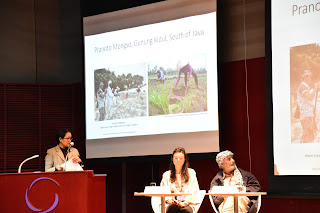
I was invited to share my thoughts during the International Symposium on Water and Culture in Tokyo, 3-4 February 2020. The subtitle of the symposium was Learning from Water Heritage to Innovate Regional Development.  Basically, this was a platform to create a dialogue between experts in water and heritage. Speakers from all corners of the world gathered to share their knowledge and experience about water and culture. I have chosen to talk about traditional water management of Indonesia with case studies of Subak (Bali), Aia Adat (West Sumatra) and Pranoto Wongso (Java). Those are irrigation systems based on local wisdom and tradition that have been surviving for many generations.  Traditional knowledge as the sum of local solutions and techniques, which include farming practices, models of water management, everyday habits, artifacts and even behavior and spiritual values.  The Symposium contributed to creating a new horizon of water discussion lea...

A DREAM

Image
I have entered the new year of 2020 with a dream. Confirmation of a dream that has been in my whole system for years: how to transform heritage societies in Indonesia to become professional organizations? Professional in the sense that cultural heritage is recognized as a profession united in an association, with code ethics and remuneration standard. Cultural heritage professionals would be able to work fulltime officially as independent experts or attached to institutions with peace of mind to know that he or she has no worry about steady and proper income. After more than three decades of the cultural heritage movement in Indonesia, it is time to recognize the roles and importance of heritage societies; the pioneers, the volunteers, the followers and anyone who stand up to save Indonesian heritage. During one of the modules as the pre-PhD student at the Leiden University last week, I shared my dream to find out how to make heritage societies in Indonesia as professional entit...

PLANTATION HERITAGE

Image
The theme of plantation doesn’t receive much attention as deserved from the industrial heritage professionals and researchers in Indonesia specifically and in Asia generally. But for Medan, the theme of the plantation is very relevant and urgent.  Medan is the capital of North Sumatra Province, Indonesia, a city of about 2, 5 million inhabitants. The city is a multicultural society with influences from India, China, Europe, Java, Malay, Aceh, Batak, and other ethnicities.  This multiculturalism due to the fact that in the colonial era the Dutch-Indies government has imported labors from outside to open plantations. The local ethnics, Batak and Malays, have refused to cooperate with the colonial government, enforced the authorities to attract the Indians and Chinese overseas especially from the Malacca Straits to come to Medan. The tobacco was introduced in 1863 by the Dutch and soon it took over the world market together with the Cuban cigars. There were...

A LONG BREATH FOR INDUSTRIAL HERITAGE

Image
The industry is one of the most exciting fields in cultural heritage to look at, especially in Asia, where industrial heritage is not widely known yet. The industry associates more with economic development but not yet with social and cultural development. This should be changed considering that the industry becomes one of the development backbones of Asia. Assets and potentials are tremendous. Interests and enthusiasm, especially from young professionals are huge. Everybody is hungry and thirsty for knowledge and examples from the field! Those are my personal motivation why I dedicate my attention in the last few years to industrial heritage in Asia and in Indonesia specifically. It is with pleasure to be part of the ANIH (Asian Network for Industrial Heritage) with its newly launched website. Through this website, we can see we do our best to promote the industrial heritage of Asia for larger public.  In 2020, ANIH will hold its Third Forum in Sawahlunto, Indonesia. Fo...

WHEN CULTURE IS YOURS?

Image
A while ago I visited an exhibition with a theme Things That Matters in the Tropen Museum, Amsterdam.  In the exhibition, there were several angles were exposed: what we wear, when we feel at home, how climate changes our culture, our happy memories from home, how we create new life, the meaning of language, beliefs, fighting for our ideals, and celebrations.  One of the topics in the exhibition is about claiming a culture. When can we say that culture belongs to us? These are the words quoted from the Tropen Museum: Sharing or stealing? Is it acceptable to take over things over from a culture that’s not your own? And who gets to decide? In the last few years, there’s been much debate about issues like these, particularly on social media. This debate focuses on cultural appropriation: the co-option of elements from another culture for one’s own purposes or profit. Things like symbols, clothing, hairstyles, dance, music or language, for example. Obviously, cu...

THE BEATLES AND HUMAN CAPITAL

Image
When I had an idea to establish Sumatra Heritage Trust (BWS) in Medan, there was hardly anyone with appropriate skills available on the grass-root level. People who were familiar with the idea of cultural heritage, in this case, historical buildings, were mostly lecturers at the local universities. We need representatives from the private sector (for financial and facilities sources) and community (as volunteers for implementation of plans and programs). That was a general idea when I looked for who was in town that I could approach to set up the organization. Medan specifically and Sumatra generally are too precious to be left alone for their cultural heritage assets without local guardians. It took me about a year to finally gather necessary numbers of the Founders of Sumatra Heritage Trust. A promising formation of 4 entrepreneurs, 2 lecturers, and 2 community representatives.  The next homework was to educate local youngsters to be cultural heritage professionals. We ...

X FACTORS OF HERITAGE CONSERVATION

Every time I was in the middle of discussions, trainings and any other events in Indonesia, I was often reminded about the presence of X Factors in heritage conservation. The first X Factor is a superstitious idea about old (read: historical) buildings. The superstitious idea is mostly about ghosts that are believed to occupy rooms and buildings. I never encountered any scientific references about how to deal with the superstitious ideas in heritage conservation. The issue about ghosts might be considered not scientific, that is why.  No matter how superstitious it is, the issue exists and as a professional, I have to deal with it. I have witnessed how this superstitious state of mind has affected the decision-making process in an adaptive reuse process of historical buildings. Layers of history are demolished and polished to be completely new features to invite visitors who are otherwise will not come to the historical buildings. It hurts and sad actually to see that the l...

INDUSTRIAL HERITAGE IN ASIA

Image
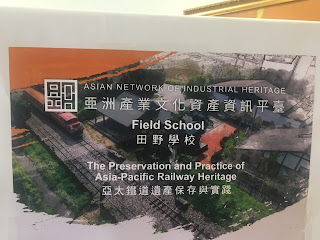
The Asian Network for Industrial Heritage (ANIH) has gathered in Chiayi, Taiwan, 30 June-5 July 2019. The theme was the history of railways heritage. I presented a paper titled " RAILWAYS HERITAGE OF INDONESIA: Celebrating Mobility in the Archipelago" and my junior colleague from Sumatra Heritage Trust, Shindi Indira presented a paper about railways history in Sumatra.  I tried to bring the ANIH 2020 to Indonesia and I tried to convince all other members of ANIH. Indonesia is relatively left behind in the field of industrial heritage compared to Europe or other Asian countries like Taiwan. It is very challenging to raise awareness about the importance of industrial heritage conservation in Indonesia, moreover about the proper practice of its conservation and adaptive reuse. That is why I was and am motivated to bring the Asian network in 2020 with the hope that it will wake up the Indonesian authorities about how industrial heritage assets might contribute to the countr...

THE FUTURE OF HERITAGE MANAGEMENT IS HERITAGE MANAGEMENT IN THE FUTURE

Image
That long title is the motto of the conference that I attended between 11-14 June 2019 at the University of Amsterdam in the frame of the   ICOMOS UNIVERSITY FORUM. It was organized by the UNESCO Chair on Heritage Futures at Linnaeus University, Kalmar, Sweden, and the Amsterdam School for Heritage, Memory and Material Culture, in collaboration with ICOMOS International, ICOMOS Netherlands, and the City of Amsterdam. It has been enlightening and inspiring 4 days of discussions and workshops with new angles of heritage practices. One of the workshops I have joined was about creating a museum for data that has been sent to a star planet. It was called "data crematorium". Or thinking about what we will do with former nuclear plants and the space shuttle. We also discussed a lot about cybersecurity and artificial intelligence. Heritage has never been so advanced before this conference for me. That is why I liked this conference a lot after avoiding conferences f...